



15 Halong Bay Cruise Quality Factors That Define a Great Trip
Planning a cruise through Ha Long Bay means navigating hundreds of options that all look similar on the surface — dramatic limestone karsts, emerald water, sunset dining, and private cabins. But once you’re onboard, the differences between a great cruise and a disappointing one become painfully clear. The cabin feels smaller than expected. The food arrives cold. The itinerary rushes through three caves in two hours. The so-called “private balcony” is shared by two other cabins.
Halong Bay cruise quality is not a vague concept. It’s a measurable combination of 15 specific factors that determine whether your time on one of Vietnam’s most iconic waterways actually matches what you paid for. This guide breaks down each of those factors in full detail — what to look for, what red flags to watch for, and how to use that knowledge to book the right cruise for your style, expectations, and budget in 2026.
Ha Long Bay Lux Cruises – Best Offers
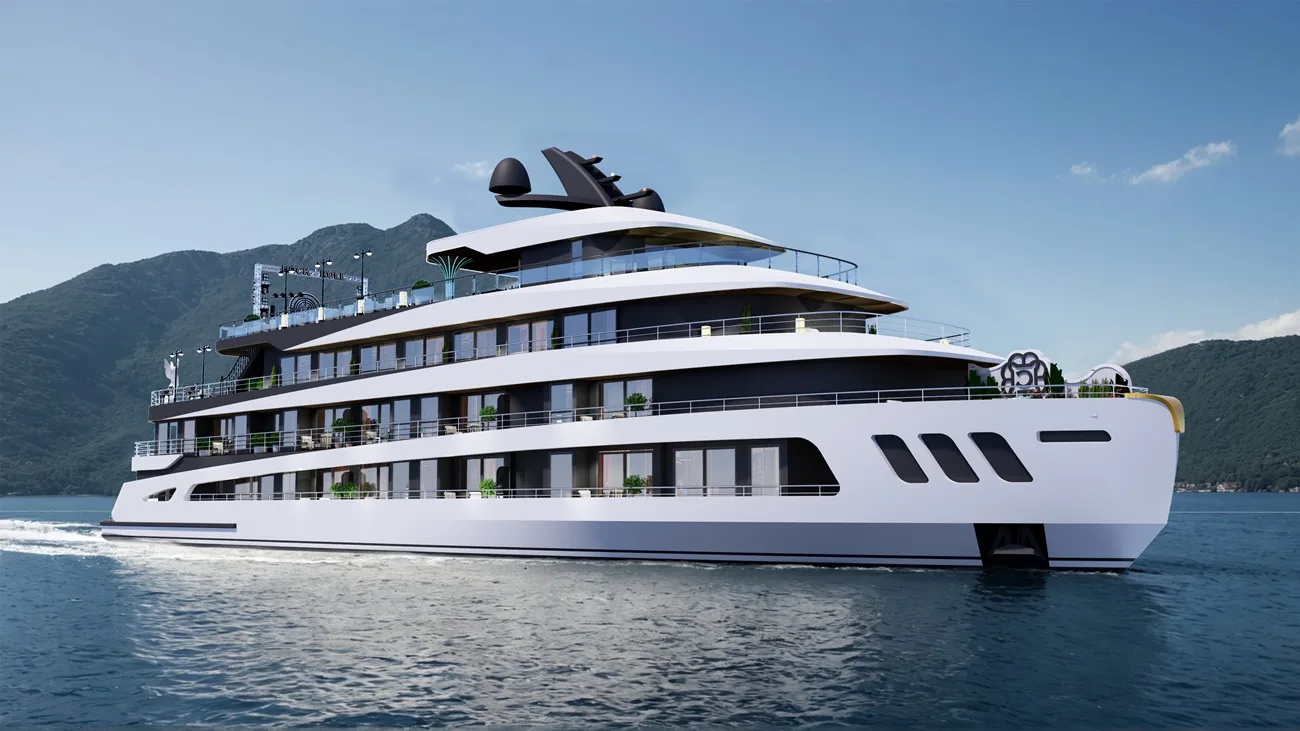
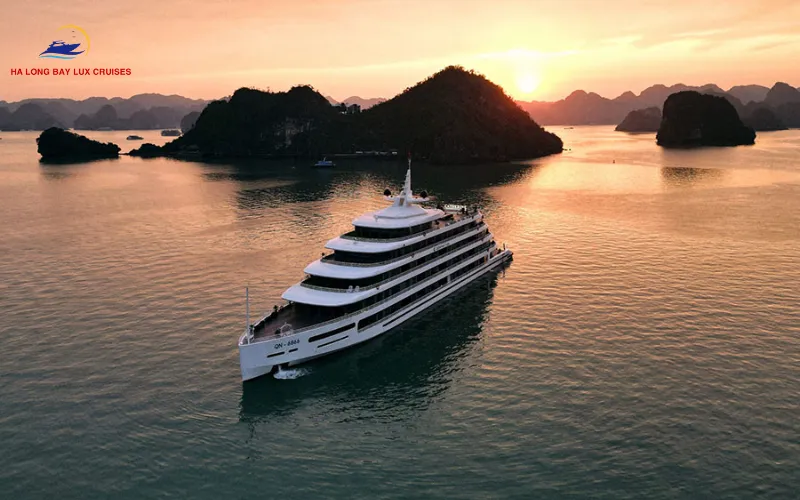
⭐ Top Rated Cruises & Tours – Getyourguide
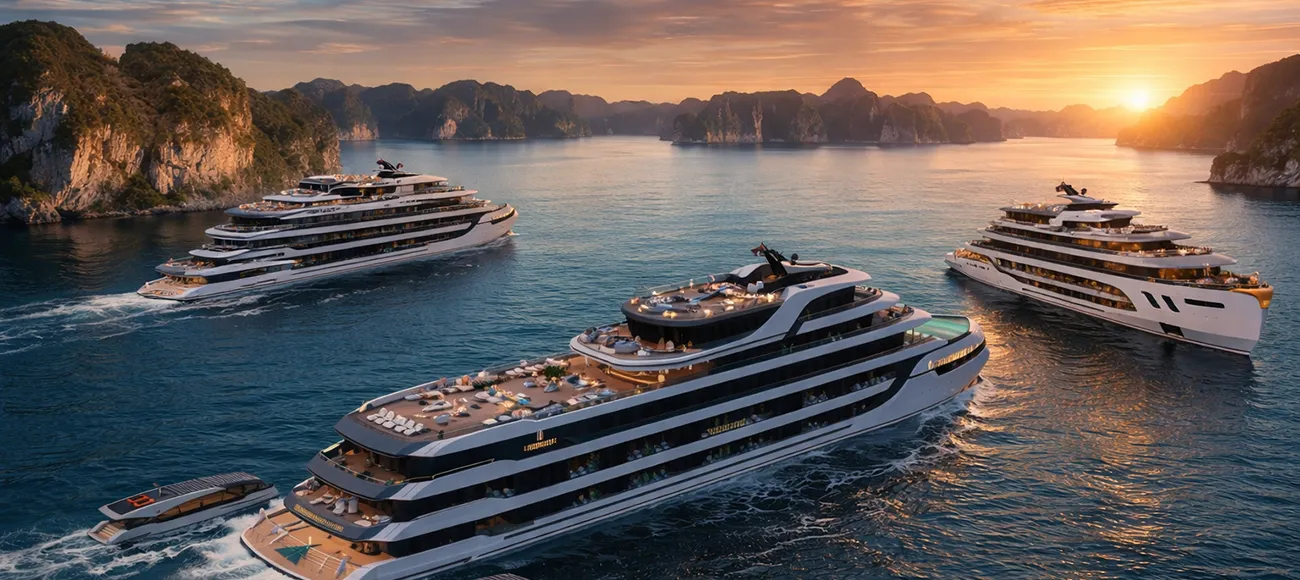
⭐ Top Rated Luxury Cruises & Tours – Viator and TripAdvisor
What “Halong Bay Cruise Quality” Actually Means — And Why It’s More Complicated Than a Star Rating
Before diving into the checklist, it’s worth understanding why star ratings alone are unreliable. Vietnam does not have a nationally standardized, independently verified star classification system specifically for cruise vessels operating in Ha Long Bay. Operators may label their cruises as 3-star, 4-star, 5-star, or even 6-star based on self-assessment or promotional positioning rather than an official third-party inspection process. Two cruises may both advertise five stars while offering very different cabin sizes, food quality, route experiences, and service standards.
True Halong Bay cruise quality is the sum of real, verifiable features — not a marketing badge.
What this means practically: two travelers booking different boats at a similar price point can have completely different experiences. One person might enjoy a spacious 38 m² cabin with a wraparound private balcony, fresh Vietnamese seafood with dietary accommodations, a well-paced Lan Ha Bay itinerary with kayaking through hidden lagoons, and attentive bilingual staff. Another traveler on a cruise with the same advertised star rating might find a 16 m² room with a porthole window, a shared deck crowded with 60 other guests, and an itinerary that spends more time idling in port than exploring the bay.
Understanding what cruise quality actually means — across cabins, routes, food, safety, and service — gives you the practical ability to tell those two boats apart before you book.
15 Halong Bay Cruise Quality Factors You Should Evaluate Before Booking
1. Cabin Size: The Single Most Reliable Quality Indicator
Cabin size is the first and most honest quality signal because it cannot be hidden once you’re onboard. Unlike photos that can be taken with wide-angle lenses or edited to look more spacious, square meters are a fixed number — and the gap between a budget cabin and a luxury suite is enormous.
Here is a practical 2026 benchmark for Halong Bay overnight cabins, based on current operator listings across the market:
- Entry-level and budget overnight cabins: approximately 12–18 m², typically found on lower-priced boats with bunk beds or narrow twin layouts
- Mid-range 3-star and 4-star cabins: approximately 18–25 m², standard beds, adequate bathrooms, usually no balcony
- Quality 4-star and 5-star cabins: approximately 25–38 m², comfortable double or king beds, bay-view windows, some with private balcony
- Luxury and 6-star balcony cabins: approximately 38–60 m², king beds, premium furnishing, full private balcony or terrace, walk-in shower, quality linens
- Presidential or Owner’s Suites on premium vessels: 60–150 m² or more, separate living area, private deck or wrap-around terrace, bathtub, premium amenities
When comparing cruises, always ask for the published cabin size in square meters. If a cruise company cannot provide this number or declines to list it on their website, that itself is a quality signal worth noting.
2. Private Balcony Access: The Upgrade That Changes Everything
A private balcony on a Halong Bay overnight cruise is not just a nice feature — it fundamentally changes the quality of your experience during what are arguably the two best moments of any cruise: sunrise and sunset.
Without a balcony, guests have to compete for space on the shared sundeck during these peak moments. On popular cruises carrying 20, 30, or even 50 passengers, this can feel rushed and crowded — exactly the opposite of the serene limestone landscape experience most travelers imagine.
With a private balcony, you wake up at 5:30 AM, slide the glass door open in your robe, and watch limestone peaks emerge from the mist with a coffee in hand. You watch the last light turn the water gold in the evening without moving from your cabin. No crowds, no noise from other guests, no competition for the best spot.
On luxury Ha Long Bay cruises, private balconies are typically standard on all cabins, not just suites. Some premium vessels offer cabin categories specifically classified as “balcony cabin,” “terrace cabin,” or “ocean view suite with private deck,” each at a different size and price. For honeymoon couples, anniversary travelers, and photographers, this upgrade is consistently worth the difference in price.
3. Bathroom Quality and Premium Amenities
Bathroom quality is one of the clearest physical signs of a cruise’s overall standard. An overnight cabin with a private ensuite bathroom that includes hot water, quality towels, and basic toiletries meets the minimum expectation. A quality luxury cruise goes considerably further.
On a quality 5-star or 6-star Ha Long Bay cruise, expect:
- A spacious ensuite bathroom, typically occupying 4–8 m² of the cabin’s total floor plan
- Separate rainfall shower or walk-in shower area
- Bathtub in selected premium suites — a rare feature that is genuinely valuable after a full day kayaking or exploring caves
- High-thread-count towels, bathrobes, and slippers
- Quality shampoo, conditioner, body wash, and dental kit
- Hot water with consistent pressure
- Well-ventilated bathroom with humidity control
- Magnifying mirror and hairdryer
Budget cabins typically offer a basic combined shower-toilet space with minimal toiletries. Mid-range cruises improve on this but often lack bathtubs, quality amenities, or proper ventilation. The bathroom is one of the areas where luxury cruise operators invest heavily because guests notice it immediately.
4. Cruise Route Design: The Difference Between a Crowded Tour and a Premium Journey
The route a cruise takes is arguably the single most powerful factor shaping whether your Ha Long Bay experience feels special or generic. Most travelers don’t realize that Ha Long Bay is divided into distinct cruising zones, and different operators have access to different areas — each with a completely different atmosphere.
Ha Long Bay (UNESCO World Heritage Core Zone)
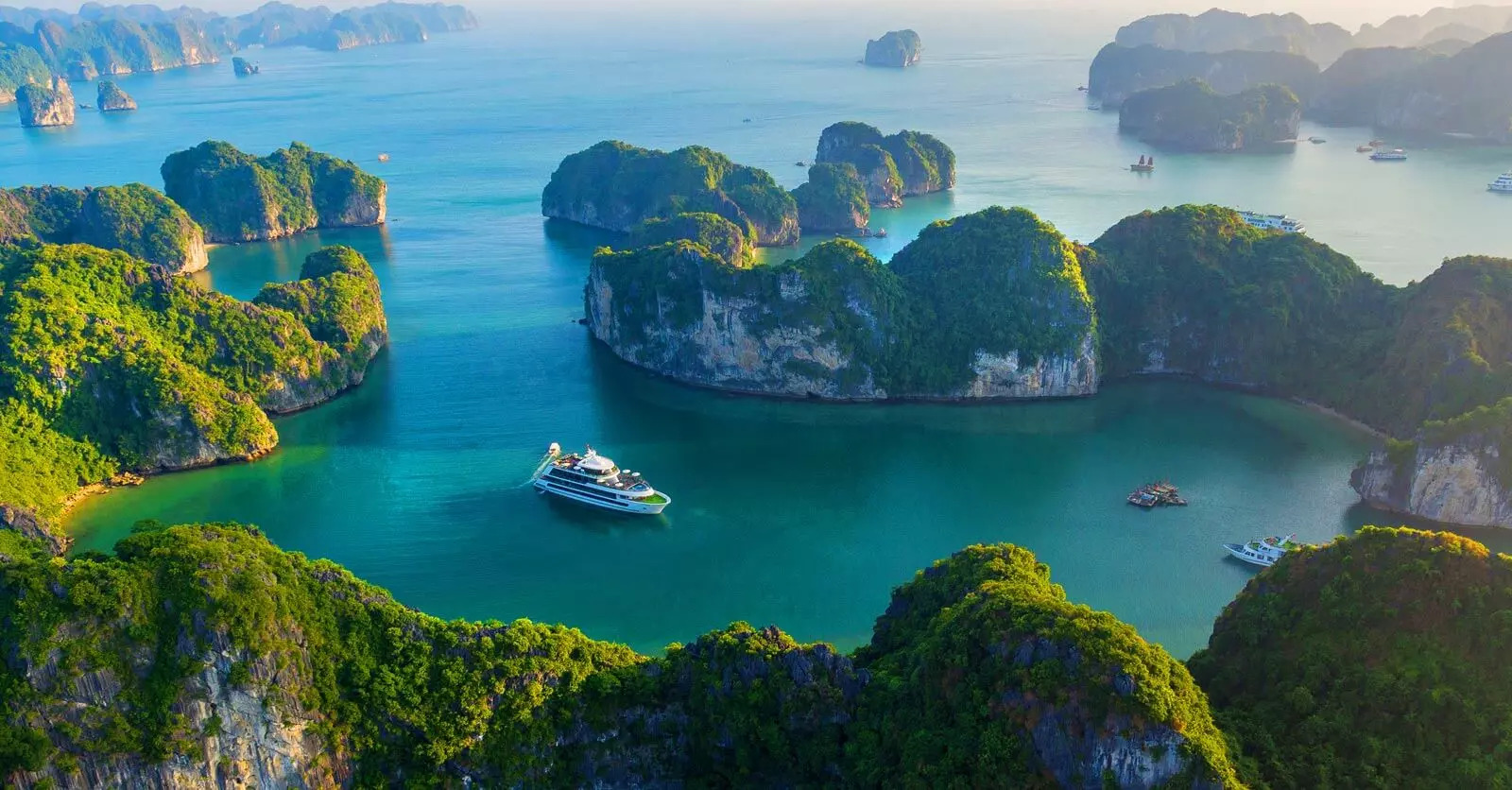
The classic Ha Long Bay route covers the central UNESCO-protected core zone, which includes approximately 775 islands within the 434 km² heritage zone. This area contains the bay’s most recognizable landmarks: Sung Sot Cave (Surprise Cave), Titop Island, Luon Cave, the Fighting Cocks Islets, and Me Cung Cave.
For first-time visitors, this route delivers exactly what most people picture when they imagine Ha Long Bay. The scenery is extraordinary — towering karst formations rising vertically from the emerald water, fishing villages on stilts, and the sense of being surrounded by one of the world’s great natural wonders. The limitation is that this zone is also the busiest. During peak travel season — November through April — popular anchorage spots can host dozens of cruise boats simultaneously.
Quality indicators on a Ha Long Bay classic route include whether the operator times cave visits for early morning (before the crowds arrive), whether the anchorage location at night is in a calm, scenic position, and whether the itinerary builds in unstructured time rather than rushing from one attraction to the next.
Lan Ha Bay (The Premium Quiet Alternative)
Lan Ha Bay lies immediately south of Ha Long Bay, adjacent to Cat Ba Island, and is part of the Ha Long Bay–Cat Ba Archipelago, which received expanded UNESCO World Heritage status in 2023. This recognition elevated the international significance of the Lan Ha Bay area and its role in the broader karst seascape ecosystem.
Lan Ha Bay includes approximately 400 limestone islands and is administratively separate from the classic Ha Long Bay zone. It typically sees significantly lower cruise vessel traffic than the main Ha Long Bay area, which creates a noticeably quieter and more private atmosphere for overnight stays.
Key Lan Ha Bay experiences include:
- Dark and Bright Cave — a kayaking-access-only cave system that opens into a hidden lagoon; only accessible by paddling through the cave entrance, which creates an adventure unlike standard cave tours
- Tra Bau area — quiet anchorage with dramatic karst scenery and minimal boat traffic, popular for overnight mooring on higher-quality cruises
- Ba Trai Dao (Three Peaches Islet) — a stunning floating beach area with three connected sandy beaches, available for swimming when sea conditions and seasonal permissions allow
- Viet Hai Village — a remote, electricity-powered community on Cat Ba Island accessible by bicycle through jungle trails, offering a genuine look at life within the biosphere reserve
- Cat Ba Island surroundings — including Cat Ba National Park, a UNESCO Biosphere Reserve, which adds ecological depth to the route
For travelers choosing between Ha Long Bay and Lan Ha Bay, the honest distinction is this: Ha Long Bay delivers the most iconic scenery and most famous landmarks. Lan Ha Bay delivers more intimacy, better kayaking, and a quieter overnight experience. For luxury cruise travelers, Lan Ha Bay is frequently the preferred route precisely because the reduced boat traffic creates a more exclusive atmosphere.
You can explore both zones on a 2-day Halong Lan Ha Bay 5-star cruise that combines the best of both bays — a particularly strong choice for travelers who want iconic Ha Long Bay scenery alongside the quieter Lan Ha Bay experience within a single itinerary.
Bai Tu Long Bay (The Least-Visited Zone)
Bai Tu Long Bay is located northeast of Ha Long Bay and offers the most remote cruising experience of the three main zones. It sees significantly less tourist traffic than either Ha Long Bay or Lan Ha Bay, which gives it a particularly undisturbed atmosphere.
Key experiences in Bai Tu Long Bay include Thien Canh Son Cave, the Vung Vieng floating fishing village, and the Cong Dam area, known for exceptionally calm water and minimal vessel traffic. The scenery in Bai Tu Long Bay is less dramatic than the core Ha Long Bay karst formations but offers a raw, unspoiled quality that appeals strongly to nature-focused travelers and repeat visitors who have already explored Ha Long Bay.
The practical limitation is that fewer premium cruise operators have regular itineraries in Bai Tu Long Bay, so the selection of high-quality boats is smaller than in the main Ha Long Bay or Lan Ha Bay zones.
5. Actual Time Spent on the Bay vs. Time in Transit
This is one of the most overlooked quality factors — and one of the most important. A cruise itinerary can advertise two days but deliver considerably less than 48 hours of actual bay experience.
Here’s the reality of how time breaks down on a standard 2-day, 1-night Ha Long Bay cruise departing from Hanoi:
- Morning of Day 1: Pickup from Hanoi hotel, approximately 7:00–8:00 AM. Limousine transfer to Ha Long or Cat Ba: approximately 3–3.5 hours one way. Arrival at pier: approximately 11:00–11:30 AM.
- Boarding and lunch: Approximately 12:00 PM onboard
- Afternoon activities: Cave visit, kayaking, swimming: 2:00–5:00 PM
- Sunset, dinner, evening onboard: 5:30–10:00 PM
- Overnight on the bay
- Morning of Day 2: Breakfast, tai chi, morning activity: 6:00–8:30 AM
- Check-out and checkout meal: 9:00–10:30 AM
- Return transfer to Hanoi: Arrival approximately 2:30–4:00 PM
The actual time actively cruising, visiting, and enjoying the bay is approximately 20–22 hours from boarding to disembarkation. A 3-day, 2-night cruise adds a full second day of activities — a day boat excursion to deeper zones, a village visit, more kayaking, and a genuinely relaxed second evening — which makes the additional cost very worthwhile for travelers who want a high-quality experience.
A quality cruise maximizes activity and experience within this window. A low-quality cruise spends unnecessary time at the pier, crowds too many stops into limited hours, or anchors in an unscenic location overnight.
6. Food Quality, Menu Design, and Dietary Flexibility
Dining onboard is one of the most consistent differentiators between cruise quality levels. On a well-run luxury cruise, meals feel like a genuine restaurant experience with bay views. On a budget cruise, food may be functional but unmemorable — or occasionally below acceptable standards.
What a quality overnight cruise should include:
- Lunch on Day 1: Typically Vietnamese set menu with seafood, fresh vegetables, rice, soup
- Dinner on Day 1: More elaborate dining with grilled or steamed seafood options, multi-course presentation, optional drinks menu
- Breakfast on Day 2: Western and Vietnamese options — eggs cooked to order, fresh bread, fruit, coffee, tea, juice
- Brunch or light lunch before disembarkation: Included on most overnight cruises, occasionally excluded on budget options
On 5-star and 6-star Ha Long Bay cruises, expect:
- Freshly prepared dishes with visible kitchen hygiene standards
- Grilled, steamed, or fried seafood using fresh daily catch
- Vietnamese cooking class option (usually making spring rolls or similar dishes)
- Sophisticated plating and service style
- Extensive drinks menu with both alcoholic and non-alcoholic options
- Clear menu explanation by the cruise manager or restaurant staff
Dietary flexibility is a genuine quality test. A high-quality cruise should be able to accommodate vegetarian, vegan, gluten-free, dairy-free, and common allergy requirements when notified at least 48 hours before departure. If a cruise cannot or will not confirm dietary accommodations when asked directly before booking, that’s a reliable signal of lower overall service standards.
The drinks situation is worth particular attention. Some cruises include welcome drinks but charge separately for water, beer, soft drinks, and wine. Others include a daily water allowance or house wine. On luxury cruises, premium beverage packages are sometimes available. Always confirm what’s included versus charged before boarding.
7. Safety Standards, Licensing, and Boat Maintenance
Safety is not the most glamorous quality factor, but it is the most important. Ha Long Bay cruise safety is regulated through a combination of Vietnam’s Ministry of Transport, Vietnam Maritime Administration, and local port authorities in Quang Ninh Province.
A properly operated cruise should have:
- A valid operational license issued by Vietnamese maritime authorities
- Life jackets for all passengers — and a clear instruction from crew on where they’re stored and how to use them
- Fire extinguishers and fire detection or suppression systems onboard
- Clearly marked emergency exits with proper signage
- Marine communication equipment — VHF radio at minimum
- A daily weather and sea condition check with compliance to port authority sailing decisions
- Safe and well-maintained tender boats for shore excursions and transfers
- Life rings, emergency flares, and appropriate safety equipment per vessel classification
The condition of the boat itself — paint, engine maintenance, deck surface, stair railings, electrical systems — also reflects the operator’s commitment to safety and quality. A cruise that looks fresh, clean, and well-maintained externally usually reflects a culture of maintenance internally. A cruise with visibly deteriorating woodwork, aging public areas, or loose or broken fixtures may not receive the same level of maintenance attention on the less visible systems.
Weather is a separate but important safety conversation. During Typhoon season (typically May through October in the Gulf of Tonkin, with peak activity July–September), Ha Long Bay cruises are subject to port authority suspension orders. A quality operator will have a clear policy for these situations — full refund, rescheduling credit, or alternative itinerary — communicated transparently before booking. A poor-quality operator may be vague about what happens in weather cancellations.
8. Service Quality and Staff-to-Guest Ratio
Service is where the experience becomes personal, and where luxury cruises consistently separate themselves from mid-range and budget options.
On a budget cruise carrying 50–80 guests, a small team of crew members handles everything — check-in, food service, cabin turndown, activity guidance, and safety management simultaneously. The result is inevitably stretched service that feels impersonal, occasionally slow, and dependent on guests advocating for their own needs.
On a quality luxury cruise carrying 20–32 guests with a larger trained team, the experience is different. Your cabin is attended to while you’re at breakfast. Staff remember that you requested a vegetarian meal and confirm it proactively. The cruise manager checks in at dinner to ensure you’re satisfied. Someone helps you understand the kayaking route before you launch. Boarding is organized, not chaotic.
Quality service indicators to evaluate before booking:
- How quickly does the cruise operator respond to your inquiry? Fast, detailed, helpful responses before booking usually reflect service culture during the cruise itself
- Does the confirmation voucher include a detailed, accurate summary of everything booked?
- Is an English-speaking cruise guide or manager listed as part of the package?
- Are there clear processes for special occasion requests — birthday cakes, honeymoon room decoration, private dining — or does the operator seem unclear about how to handle these?
- Do past traveler reviews consistently mention staff helpfulness, or do multiple reviews cite inattentive service?
For families with children, senior travelers, travelers with mobility considerations, and honeymooners, service quality often matters more than the difference between a 32 m² and a 38 m² cabin. A less spacious cabin with outstanding service frequently creates a better memory than a larger room with generic, impersonal care.
9. Itinerary Pacing and Activity Selection
Halong Bay cruise quality is also about how well the schedule is designed — not just what’s included, but how it flows.
A poorly designed itinerary might list six stops on a 2-day cruise but give you only 20 minutes at each location before rushing back to the boat. You leave feeling like you’ve seen everything and experienced nothing. A well-designed itinerary might visit only three or four places but give you a full hour of kayaking through a quiet lagoon, a relaxed walk through a village, a 90-minute cave exploration with a knowledgeable guide, and an unscheduled afternoon swim — and leave you feeling completely satisfied.
High-quality cruise itineraries are characterized by:
- A clear schedule shared before departure, with realistic times at each location
- Balance between active experiences (kayaking, cave tours, cycling) and passive ones (sundeck time, dining, photography)
- Morning cave visits timed before peak visitor hours — ideally starting cave access before 9:30 AM
- Afternoon swimming or beach time scheduled with awareness of tide and weather conditions
- Overnight anchorage in a scenic, calm location — not in the main harbor surrounded by dozens of other boats
- Optional rather than mandatory activities, so guests can choose to rest if preferred
- Evening entertainment or cultural experience such as squid fishing, Vietnamese cooking class, or local film night — not required but available
10. Transparent Pricing: What’s Included vs. What Costs Extra
One of the most reliable indicators of cruise quality and business ethics is pricing transparency. Reputable cruise operators list exactly what their price includes — and what it doesn’t — in clear terms on their website and confirmation documents.
Here’s a comprehensive breakdown of what to check:
Should typically be included in a luxury overnight cruise package:
- Onboard accommodation for the specified nights
- All listed meals (typically lunch Day 1, dinner Day 1, breakfast Day 2, and brunch before disembarkation on 2-day itineraries)
- Welcome drink
- Kayaking or bamboo boat activity
- Guided cave tour with entrance fees
- Bilingual cruise guide
- Life jacket and safety equipment
- Onboard activities (tai chi, cooking class, squid fishing at night)
May or may not be included — always confirm:
- Round-trip transfer from Hanoi (some cruises require separate booking or charge extra for private vs. shuttle)
- Drinking water throughout the cruise
- Alcoholic and non-alcoholic beverages beyond welcome drinks
- Day boat or tender boat transfer on 3-night cruises
- Tipping (not culturally mandatory in Vietnam but increasingly common on luxury cruises)
- Travel insurance
- Entrance fees to Cat Ba National Park or other protected areas on specific routes
- Bicycle rental for Viet Hai Village on Lan Ha Bay itineraries
- Spa and massage treatments
Occasionally charged without clear prior notice on lower-quality operators:
- Kayak rental (listed as “included” but charged for use)
- Drinking water above a daily limit
- Use of swimming pool on vessels that have one
- Cave entrance fees not bundled with the cruise package
A simple rule: if a cruise website doesn’t clearly list inclusions and exclusions in detail, ask directly before booking. A quality operator will answer immediately and thoroughly.
11. Vessel Age and Physical Condition of the Boat
Boat age matters — but not in the way most people assume. A 5-year-old wooden junk that has been regularly maintained and properly staffed can deliver a better experience than a 2-year-old steel vessel managed with minimal care. What matters more than chronological age is the current condition and upkeep of the vessel.
When evaluating cruise vessels for quality:
- Check for recent renovation dates — many operators have undergone significant upgrades in 2022–2025 following the COVID-era closure of Ha Long Bay (the bay was closed to tourism from early 2020 through the end of 2021, and some operators used this period to upgrade vessels while others did not)
- Look at cabin photos carefully — recent cabin photos showing clean, fresh interiors with no visible peeling, discoloration, or outdated furniture are a positive sign
- Review guest comments about vessel condition — specific mentions of “fresh paint,” “new mattresses,” “recently renovated cabins,” or conversely, “musty smell,” “old cabin,” or “outdated bathroom” reflect actual conditions that photos may not
- Check the name and registration year of the specific vessel — some operators run multiple boats under the same brand name at different quality levels; confirm which vessel your booking is on
A quality cruise operator will identify the specific boat you’re booking, not just the brand. Vague booking confirmations that say “or similar vessel” without locking in the specific boat are a concern.
12. Guest Reviews: How to Read Them Critically for Quality Signals
Guest reviews on platforms such as TripAdvisor, Google, and Booking.com are valuable quality signals — but only if you know how to read them critically rather than simply averaging scores.
How to extract reliable quality information from reviews:
- Focus on reviews from the past 12 months, not overall ratings that include reviews from 5 years ago. Cruise vessels are renovated, staffed differently, and managed with changing standards over time. A 4.8/5 average score that includes many pre-COVID reviews from 2017–2019 may not reflect current conditions.
- Look for specific, detailed reviews rather than general ones. “Great experience!” tells you nothing. “Our cabin was 38 m², very clean with a working A/C and the private balcony had a beautiful view at sunset” tells you a great deal.
- Pay attention to consistent patterns across multiple reviewers. If three separate reviews mention slow dinner service, that’s a pattern. If one review mentions it and twenty don’t, it may be an outlier.
- Look for management responses to negative reviews. A quality operator responds professionally to complaints, acknowledges issues, and explains what was done. An operator that ignores negative reviews or responds dismissively has lower service standards.
- Be cautious of uniformly perfect reviews with very similar phrasing — these may not reflect authentic guest experiences.
13. Transfer Quality from Hanoi to Ha Long Bay
The cruise itself begins and ends with the transfer between Hanoi and Ha Long Bay, and transfer quality significantly affects the overall experience in ways that are easy to underestimate.
The distance from Hanoi’s Old Quarter to Ha Long Bay pier is approximately 165–175 km, which takes roughly 3–3.5 hours by road, depending on traffic and the specific pier used. Cat Ba Island pier (for Lan Ha Bay cruises) involves an additional ferry or speedboat transfer from the mainland.
Transfer options and quality considerations:
- Limousine van (private or semi-private): The highest-quality transfer option for groups of 4–9 passengers. Comfortable seats, charging points, on-time service, English-speaking driver, and flexible pickup location. Increasingly standard on 5-star and 6-star cruise packages.
- Shared shuttle bus: Economy transfer joining other passengers traveling independently. Less flexible departure times, may include multiple hotel pickups extending total journey time. Acceptable for budget and mid-range bookings but creates a less refined start to a luxury cruise.
- Private car: Available for 1–3 passengers or for travelers who want a fully private door-to-door transfer at a higher per-person cost.
A quality luxury cruise package should either include a limousine transfer or offer it clearly as an upgrade. Arriving at the pier in a comfortable vehicle that departs on time, with a driver who meets you at your hotel with a name sign, is a meaningful quality-of-life difference compared to an uncertain shared bus pickup.
14. Specialized Amenities on Premium Cruises: Spa, Pool, Gym, and Wellness
For travelers booking at the luxury end of the market, the onboard amenities beyond the cabin and dining room become increasingly relevant. Not all luxury cruises offer the same facilities, and it’s worth knowing which categories of amenities exist and which vessels provide them.
Spa and massage rooms are available on a growing number of 5-star and 6-star Ha Long Bay vessels. These typically offer traditional Vietnamese massage, aromatherapy, facial treatments, and body scrubs. Sessions range from approximately 60–120 minutes and are priced separately from the cruise package. For travelers arriving after a long-haul flight or seeking a relaxing two-day rhythm, onboard spa access is a genuine quality upgrade.
Outdoor hot tubs or Jacuzzis are available on selected premium vessels and represent one of the most distinctive luxury features available in Ha Long Bay. The image of soaking in a private or semi-private hot tub on a quiet evening with limestone silhouettes in every direction is particularly compelling for couples and honeymooners.
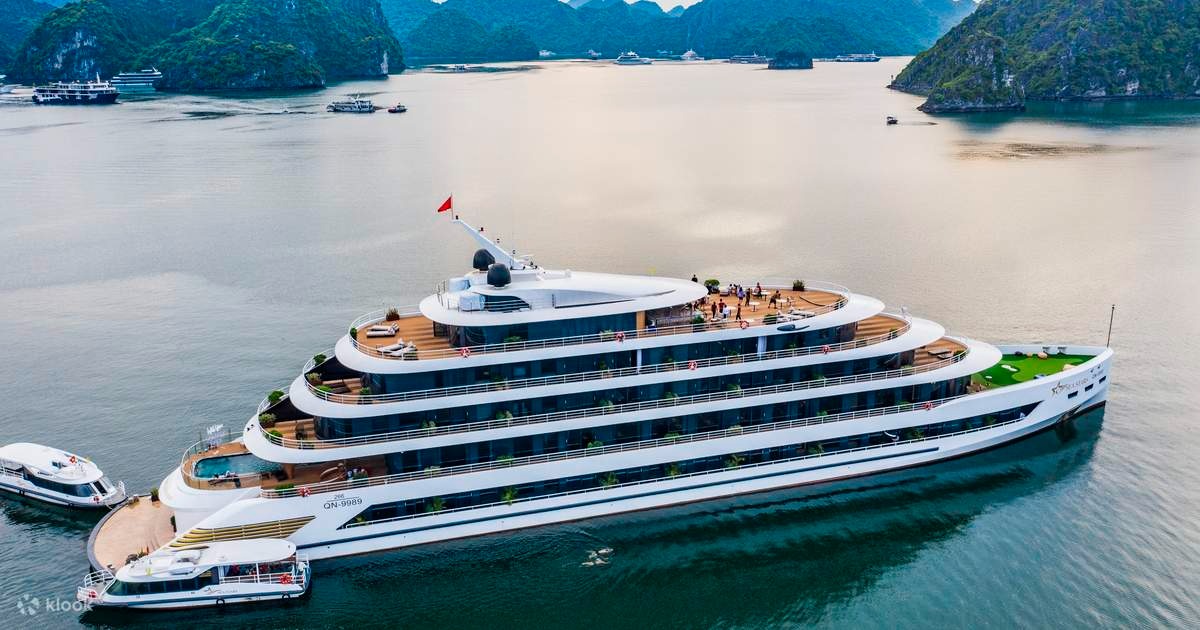
Swimming pools are increasingly available on larger premium vessels, including several of the top-tier 6-star boats. On these cruises, an onboard pool complements rather than replaces the bay swimming experiences in the itinerary — guests can swim in the pool on the boat while anchored in quiet waters, then kayak and swim in the bay itself during the afternoon.
Fitness rooms are a minority feature but available on select premium vessels. Typically small — often 15–25 m² — they usually include a treadmill, exercise bike, and free weights.
Sun terraces and sundeck design also vary significantly. A quality luxury cruise should have a well-designed sundeck with proper loungers, shade structures, a bar, and bay views on multiple sides. Overcrowded sundecks with plastic chairs that were clearly not designed for the number of guests onboard are a quality red flag.
For a comprehensive view of what a 6-star cruise experience looks like across these amenity categories, explore the 6-star Ha Long Bay cruise options on Halong Bay Lux Cruises — which outlines specific vessel facilities, cabin sizes, and premium itinerary designs at the highest quality level available on the bay.
15. Booking Support, Communication, and Post-Booking Service
The final quality factor operates before and after the cruise itself — and it’s one that significantly affects your confidence and overall experience.
How a cruise operator handles your inquiry, answers your questions, manages your booking, and supports you in the event of changes or problems is a direct reflection of their service culture. A company that responds thoughtfully, proactively, and accurately before you’ve paid is very likely to deliver the same quality when you’re onboard and needing something.
Signs of strong booking support quality:
- Response within 24 hours with specific, accurate answers to your questions
- Detailed quote that matches your travel dates, cabin preference, dietary needs, and transfer requirements — not a generic brochure copy-and-pasted response
- Ability to answer specific questions about cabin size, route, activities, and inclusions from direct knowledge rather than vague “yes, of course” responses
- Proactive follow-up with updated information as your travel date approaches — weather notes, packing suggestions, pier location details, what to bring
- Clear and written confirmation of cancellation and refund policy before payment
- Accessible contact during the cruise itself in case of urgent issues
Halong Bay Lux Cruises specializes in curated premium and luxury cruise selection across Ha Long Bay, Lan Ha Bay, and Bai Tu Long Bay, offering this kind of personalized support throughout the booking process. Rather than presenting a long list of undifferentiated options, the team helps travelers compare real differences — route quality, cabin specifications, vessel condition, activity programs, and value at each price point — so the final choice is genuinely matched to what each traveler is looking for.
Which Cruise Duration Delivers the Best Quality Experience?
Once you’ve evaluated quality factors across boats, the next decision is cruise length — and it has a real impact on the depth of your experience.
Day Cruise: When It Makes Sense
A Ha Long Bay day cruise typically runs 6–8 hours on the bay, departing from the pier mid-morning and returning in the late afternoon. Activities usually include one cave visit, a kayaking segment, and onboard lunch. Day cruises work well for travelers with only one free day in the Hanoi region, or for guests already staying in Ha Long City who want to experience the bay without an overnight commitment.
The honest limitation: a day cruise cannot replicate the emotional quality of a sunset from a private balcony, dinner on still water surrounded by limestone peaks, or a dawn mist experience from the sundeck. These are exclusively overnight experiences.
2-Day, 1-Night: The Classic Quality Experience
For most first-time visitors, a 2-day, 1-night cruise is the most practical way to experience Halong Bay cruise quality in full. You get the full arc of the experience — arrival, afternoon activities, sunset, dinner, night ambiance, sunrise, morning activities, and a satisfying send-off. For a couple, this is usually the sweet spot between cost and experience.
3-Day, 2-Night: The Highest Itinerary Quality
If time allows, a 3-day, 2-night cruise offers demonstrably better quality in several ways. The middle day is a full day on the bay — allowing for a deeper excursion by day boat, a longer kayaking session, a village visit, and a relaxed second evening that doesn’t feel like a farewell dinner. The pace is slower, the activities are richer, and the overall memory is more complete.
For Lan Ha Bay itineraries specifically, 3 days and 2 nights allows proper exploration of Dark and Bright Cave, Viet Hai Village, Tra Bau, and Ba Trai Dao in a way that doesn’t feel rushed. If you’re investing in a luxury cruise, investing the additional day to match itinerary depth with accommodation quality is almost always the right decision.
Red Flags That Signal Poor Halong Bay Cruise Quality
Knowing what to avoid is as useful as knowing what to look for. These specific warning signs consistently appear in low-quality cruise experiences:
- No cabin size listed anywhere on the website or in the quote — this is almost always intentional concealment
- Unusually low price compared to market rates for similar duration and cabin type — a 2-day luxury cruise with private balcony that costs significantly less than 95% of comparable options usually reflects a meaningful quality compromise somewhere
- Photos that clearly use extreme wide-angle lenses or heavy post-processing to make tiny spaces look larger
- Itinerary that lists 6–8 stops for a 2-day cruise — this almost always means rushed visits with no depth of experience
- Vague or evasive responses to specific questions about cabin size, route, or inclusions
- No mention of which specific vessel you’ll be on — bookings that reference only a brand name without identifying the boat
- Recent reviews mentioning mechanical issues, smell problems, or pest sightings on the boat
- Transfer details that are unclear about pickup timing, location, or whether transfer is private or shared
- No written cancellation policy provided before payment requested
How to Book a Quality Halong Bay Cruise with Full Confidence in 2026
The best approach to booking is simple but requires a small amount of preparation. Before confirming any cruise, get clear written answers to these questions:
- What is the exact name of the vessel I’ll be onboard?
- What is the cabin size in m² for my specific cabin category?
- Does the cabin have a private balcony?
- Which bay does the itinerary cover — Ha Long, Lan Ha, or Bai Tu Long?
- What are the specific stops and approximate times at each location?
- What meals are included, and how are dietary requirements handled?
- Is the Hanoi round-trip transfer included, and is it private or shared?
- Are kayaking, cave entrance fees, and all activity costs included?
- What is the policy for cancellation by the traveler? By the operator? For weather?
- What is the exact payment and refund procedure?
A quality operator answers every one of these questions clearly, in writing, before asking for payment.
Frequently Asked Questions About Halong Bay Cruise Quality
What is the most important quality factor when choosing a Halong Bay cruise?
Cabin size and route design are consistently the two most impactful factors. Cabin size determines your physical comfort and privacy; route design determines whether you experience an intimate, well-paced journey or a crowded rush through tourist landmarks.
Is a 6-star Halong Bay cruise worth the premium price?
For travelers who prioritize large private cabin space, a balcony, premium dining, spa access, high staff attention, and a well-curated route — yes, absolutely. A genuine 6-star cruise provides a measurably different experience across every quality factor in this guide. For budget-conscious travelers, a well-chosen 4-star or 5-star cruise with a private balcony cabin and Lan Ha Bay route can also deliver excellent value.
How crowded is Ha Long Bay, and does route choice really matter?
Route choice matters significantly. The main Ha Long Bay UNESCO zone is the most visited area and can feel busy during peak season (October–April). Lan Ha Bay typically receives lower boat traffic and feels more exclusive. Bai Tu Long Bay is the quietest of the three main zones. For a luxury cruise, Lan Ha Bay is frequently the top recommendation for this reason.
What is the best time to take a Halong Bay cruise for quality weather?
The optimal weather period for Ha Long Bay cruises is October through April, when northeastern winds bring cooler, drier conditions with generally good visibility. March and April offer warmer temperatures with calm seas. The summer months of June through August bring higher humidity, warmer temperatures, and the possibility of typhoon-related disruptions. November through January can occasionally be too cold and foggy for comfortable swimming but offer dramatic atmospheric scenery.
Can I book a Halong Bay cruise just a few days in advance?
On premium and luxury cruises, availability varies considerably. Popular boats on peak-season dates (including Vietnamese national holidays such as Tết in late January or early February, and public holidays in April and September) can sell out weeks or months in advance. Booking 4–8 weeks ahead for a 2026 peak-season luxury cruise is advisable to secure your preferred vessel and cabin category.
What is the difference between Ha Long Bay and Lan Ha Bay in terms of cruise quality?
Ha Long Bay offers more famous landmarks and a wider choice of vessels. Lan Ha Bay offers a quieter atmosphere, better kayaking options including Dark and Bright Cave, access to Cat Ba Island, and generally less crowded anchorage — which makes it the preferred route for many luxury cruise travelers. Both routes are genuinely beautiful; the choice depends on whether iconic scenery or peaceful immersion is your priority.
Hotline | WhatsApp: +84.978.358.422
Phone | WhatsApp: +84.962.261.687
Email: halongbayluxcruises@gmail.com or vietnammarveltravel@gmail.com
Website: halongbayluxcruises.com
Reviews: Top Halong Bay Cruise Reviews on TripAdvisor
Fanpage: https://www.facebook.com/halongbayluxcruises
Book Your Luxury Halong Bay Experience
Contact Halong Bay Lux Cruises now via Hotline | WhatsApp: +84.978.358.422 for pricing and special offers!
Thousands of travelers from Europe, UK, USA, and Australia have rated us 5-stars for our exceptional service and unforgettable Halong Bay luxury experience.